Author: Elaine V

The Changing Economics of Solar for Commercial Real Estate

How Federal Deadlines, Compliance Obligations, and Ownership Options Are Reshaping Solar Decisions

Estimated reading time: 6 minutes

At a Glance

  • Site-ready solar projects contracted in 2026 may still qualify for the 30% federal tax credit if operational by December 31, 2027.
  • Expanding building-performance requirements are increasing the financial cost of delaying energy and emissions improvements.
  • Direct ownership, site leases, and portfolio-level strategies give owners multiple ways to create value, depending on timing, capital, and property readiness.

Introduction

Commercial building owners are navigating a dynamic and fast-changing energy landscape shaped by increasing electricity demand, rising electricity costs, and compliance obligations under new and expanding building electrification ordinances. Distributed solar is the lowest-cost and fastest technology to deploy to meet this moment. However, changes to federal tax incentives and project qualification deadlines are making the timing and structure of solar projects increasingly important.

Building owners now must consider not only whether a property is suitable for solar, but also how quickly a project can be developed, and whether direct ownership, a lease structure or a combination of approaches will deliver the greatest long-term value for each property and at the portfolio level.

This market update covers the federal incentive deadline, the compliance costs building performance ordinances can create, the ownership and financing structures available, and how to choose a partner who can execute within the prescribed timelines.

The Window for the Federal Tax Credit Is Narrowing

The 30% Investment Tax Credit (ITC) remains available for qualifying projects and accelerated bonus depreciation continues to provide significant tax benefits available for new projects.

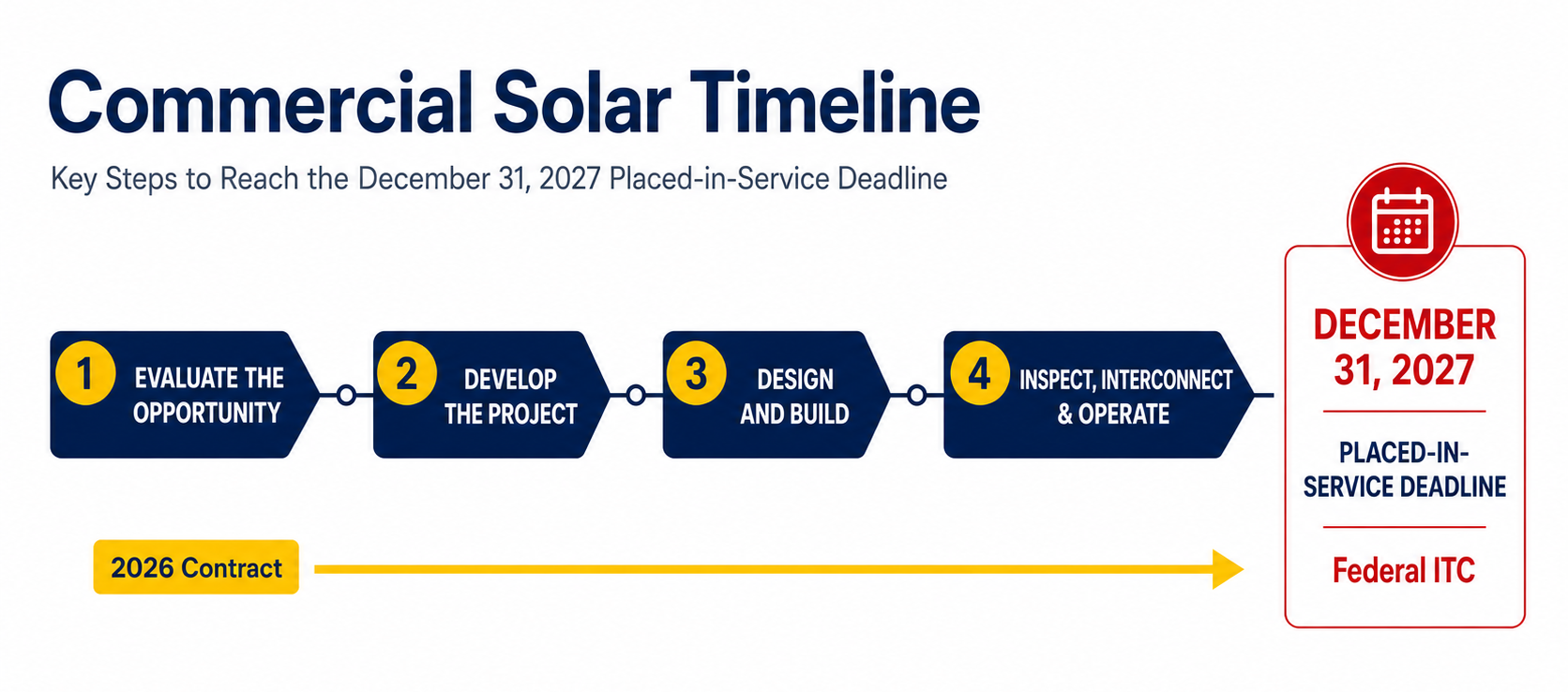
What’s changed is the ITC timeline. The construction-start deadline that allowed projects to lock in a longer completion window has passed. Systems starting construction now must be placed in service by December 31, 2027, to qualify for the ITC — roughly a year and a half to be fully installed, interconnected, and generating power. That’s workable for most properties if contracted in 2026, but there’s little room for delays in permitting, utility interconnection, procurement, or construction.
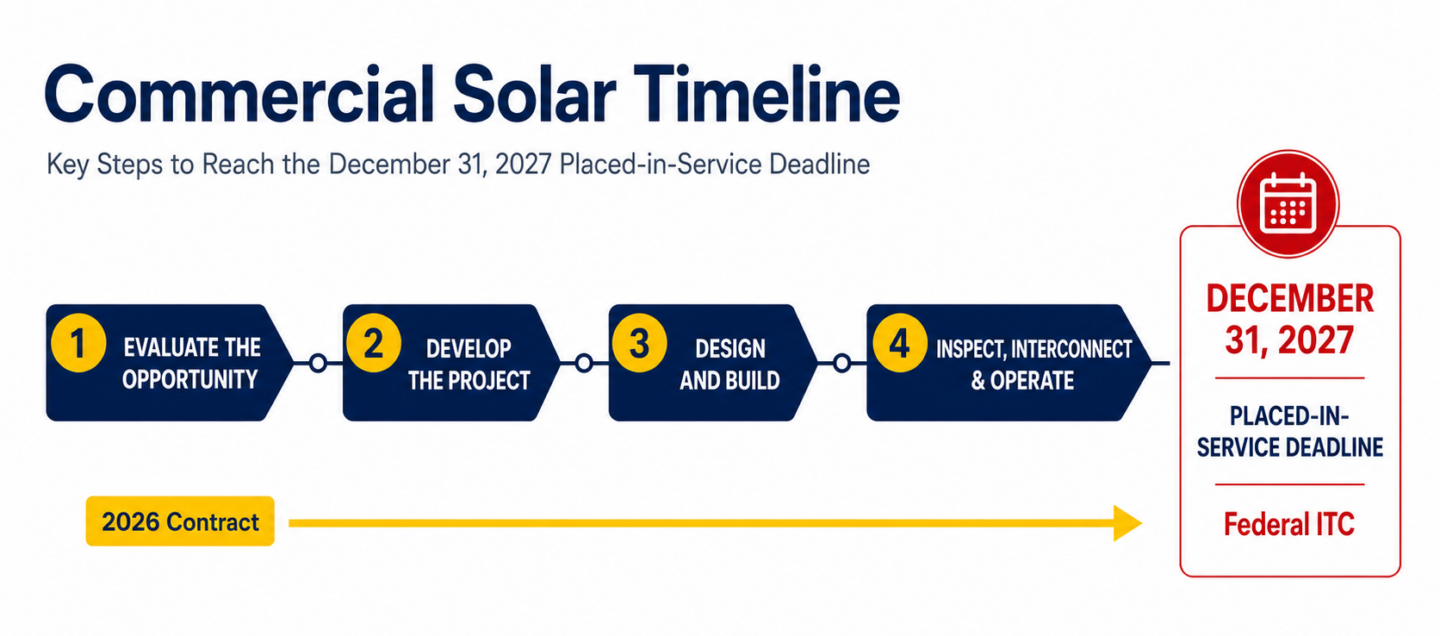
For many properties contracted in 2026, completing the project in time to qualify for the ITC remains feasible, provided the property is ready for a 2027 installation and sufficient utility interconnection capacity is available.

Owners and developers who evaluate properties now will have more flexibility and time to compare ownership and financing structures, coordinate solar with capital improvement plans or roof replacement projects, and align the project installation schedule at the chosen properties. While the fundamentals of solar look good with and without the ITC, projects that monetize 30% of the project cost will have superior financial returns.

Building Performance Requirements Raise the Stakes

The ITC is not the only clock running. State and local building codes, emissions reduction targets, and corporate sustainability commitments are creating new performance standards and financial obligations for commercial building owners. Although many policies include transition periods, owners must begin planning and implementing improvements early enough to meet increasingly stringent requirements.

In Massachusetts, policies such as BERDO in Boston, BEUDO in Cambridge, and Large Building Energy Reporting (LBER) are encouraging owners to reduce emissions and improve building performance. Similar policies are emerging throughout the Northeast.

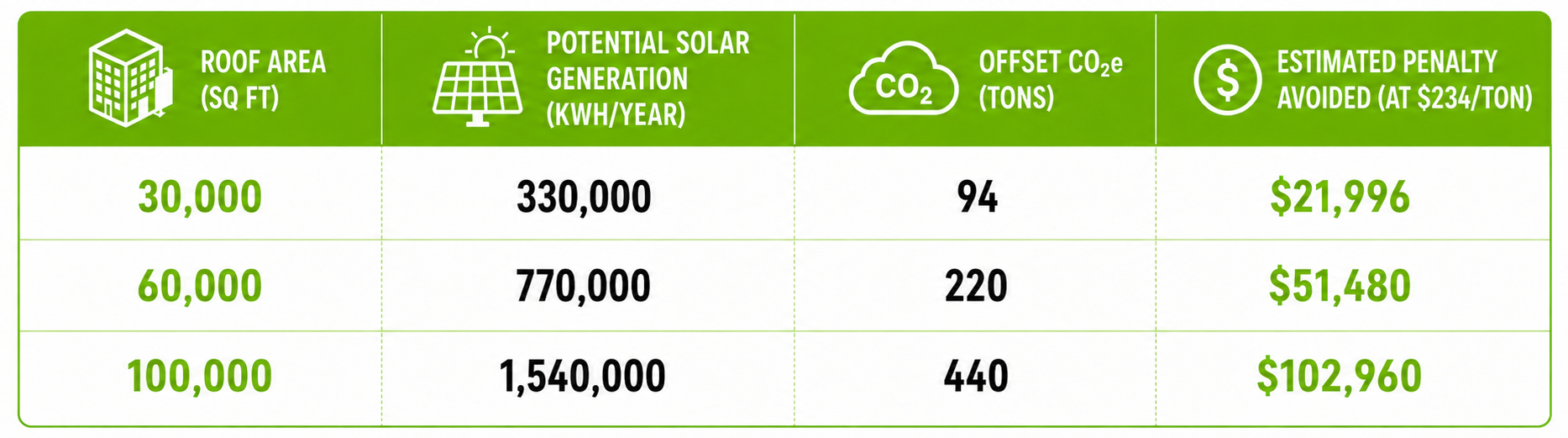
For many owners, these policies have moved beyond reporting requirements and now include real fees for non-compliance. Buildings in Boston that exceed their BERDO emissions limits face Alternative Compliance Payments of $234 per metric ton of CO₂e plus $1,000 per day for every day of non-compliance. Onsite solar can directly offset that exposure. Eligible Massachusetts Class I Renewable Energy Certificates from qualifying onsite or offsite renewable energy resources may also be used to support BERDO compliance, subject to applicable program requirements.

Potential Compliance Costs Avoided with Onsite Solar
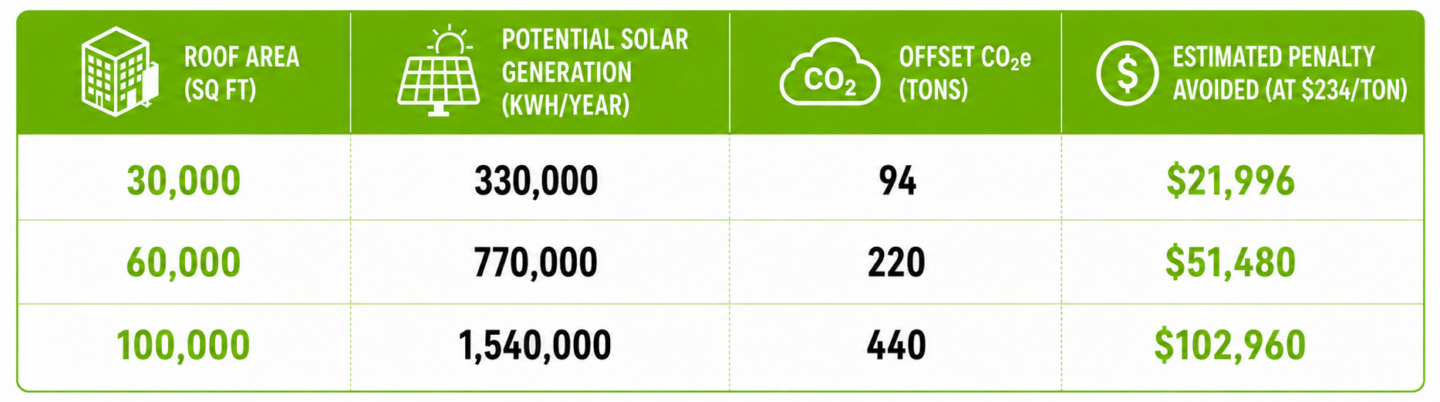
While this example is specific to Boston, it illustrates how building performance policies can have measurable financial implications. Actual solar production, emissions reductions, and avoided compliance costs will vary based on building energy use, system design, applicable emissions limits, and reporting requirements.

Choosing the Right Solar Ownership and Financing Approach

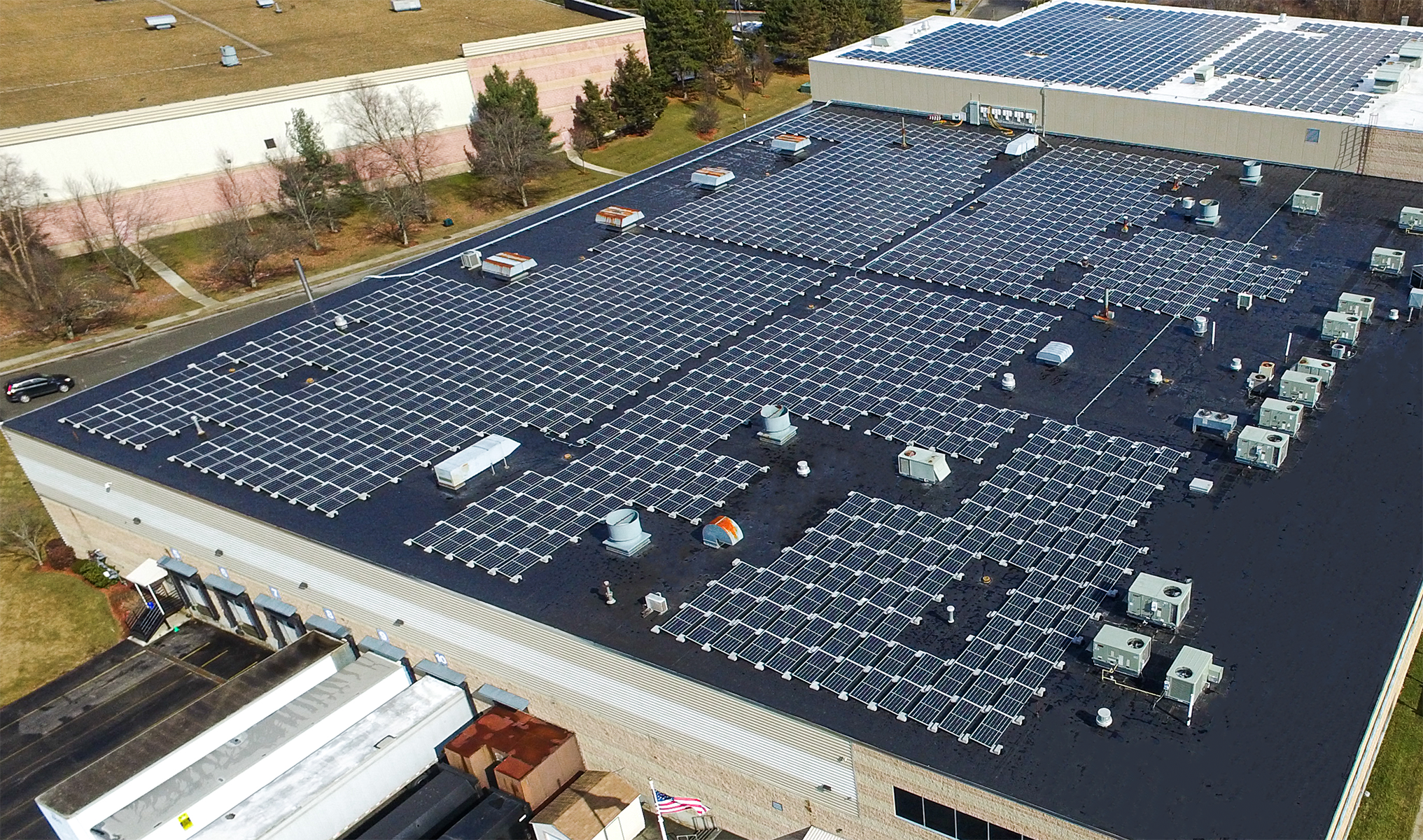
Large rooftops, parking lots, and land can host solar installations that generate near-term and long-term financial returns. However, there is no single ownership structure that is right for every commercial property. The right approach depends on timing, site readiness, who pays the electric bill, available capital, ownership objectives, and the property’s role in the broader portfolio. For some properties, direct ownership may produce the strongest financial returns. For others, a site lease may better align with the owner’s capital priorities, timeline, or property strategy.

Direct Ownership

Direct Ownership – Behind-the-Meter

Where the building owner pays the electric bill, installing the system behind-the-meter may offer the greatest value. Powering the building with onsite solar reduces the amount of electricity purchased from the utility and limits exposure to volatile and rising grid-delivered electricity costs. Depending on the project and jurisdiction, additional value may come from state incentives, federal tax benefits and depreciation, and reduced building-performance compliance costs.

Direct Ownership – Front-of-the-Meter

A building owner may prefer to invest in a system that sends electricity directly to the grid. Rather than offsetting the building’s electric use, the project generates revenue through a 20-year tariff agreement with the utility. This is a highly predictable and bankable income stream backed by an investment-grade counterparty.

Allocating Credits Across a Portfolio

Depending on the applicable state program and utility rules, a project may be able to direct bill credits to other eligible properties. This can be particularly valuable for owners seeking to offset high electricity costs or reduce emissions exposure at buildings subject to requirements such as BERDO.

Solar Site Leases

For owners that do not want to invest capital, cannot use the available tax benefits, or cannot complete a purchased project by the end of 2027, a rooftop solar site lease may be the strongest option. The developer finances and maintains the projects and pays rent to the building owner. Depending on the configuration and the applicable solar program, the project may also contribute to building-performance compliance.

In preparation for the ITC safe harbor deadline, Solect invested in more than 100 MW of solar equipment intended to support future projects. Because Solect can finance and own site-lease and power-purchase-agreement projects, ITC-eligible equipment and federal tax benefits can be incorporated into project economics, potentially supporting more competitive lease payments or energy pricing.

Case Study: Direct Ownership and Site Leases Within the Same Portfolio — Parsons Commercial Group

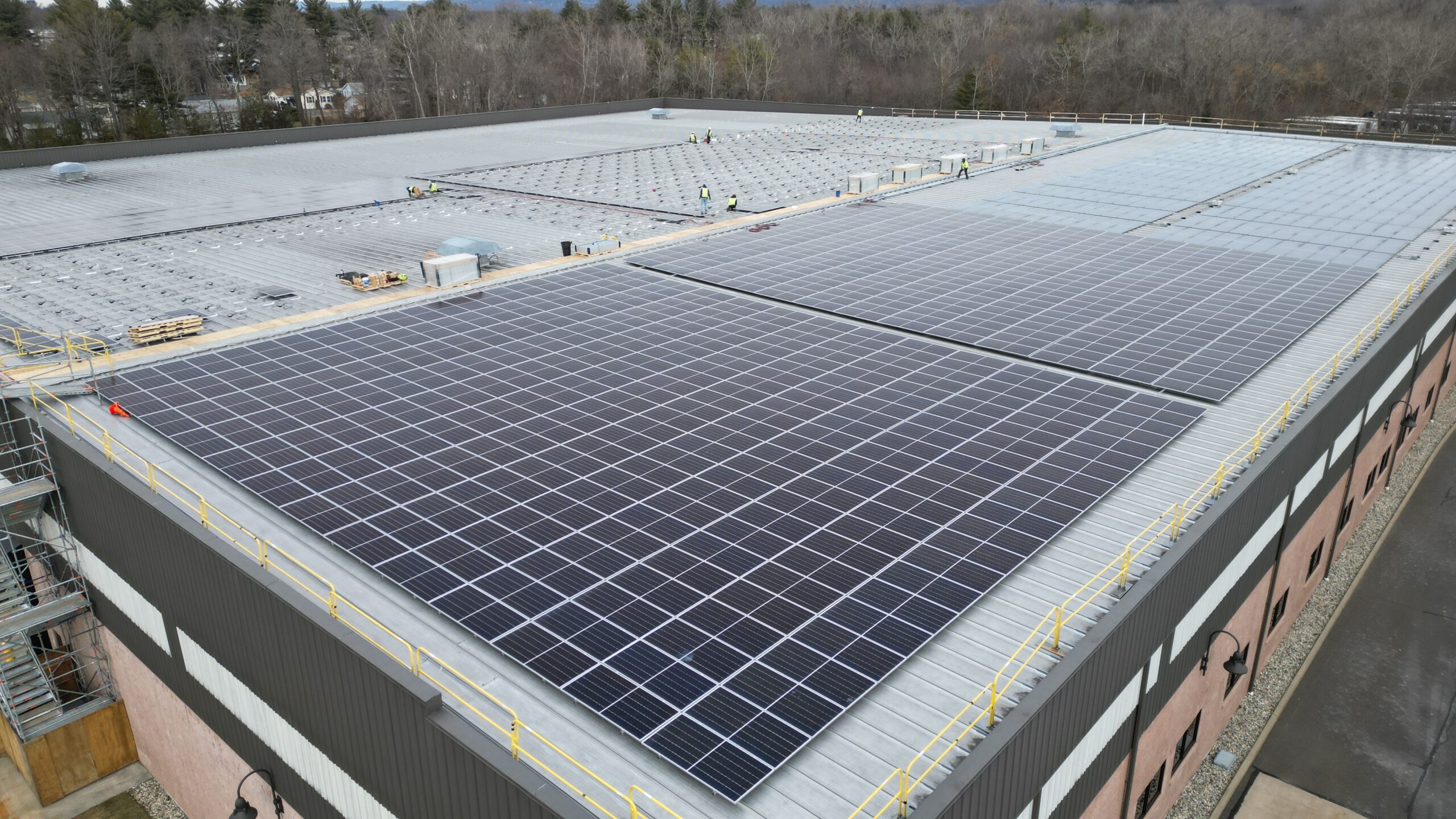
Solect’s relationship with Parsons Commercial began in 2015, when Parsons, Solect’s landlord at its Hopkinton, MA operations center, became interested in how solar could add value across its properties. Parsons’ initial projects were installed at Solect’s building and two others. Since then, through new acquisitions and property sales, Solect has continued developing projects at Parsons properties. As of 2026, twenty-two projects are complete, split nearly 50/50 between direct ownership and Solect-financed site leases. Ongoing monitoring and asset management have supported strong system performance and strong financial returns.

Choosing the Right Partner

As project timing and structure become more important, commercial real estate owners need a solar partner that can support more than a single transaction or installation. The right partner should be able to evaluate opportunities across a portfolio, recommend the structure that best aligns with each property, and carry projects from initial feasibility and financing through design, construction, commissioning, and long-term asset management.

That requires financial strength, policy and market expertise, in-house design and engineering resources, proven installation capabilities, and a strong record of operating and maintaining solar assets over time — along with financing flexibility, since some owners will choose to purchase and own their systems while others prefer a third-party-owned structure with no upfront capital required.

Since 2009, Solect Energy has served businesses and commercial building owners throughout Massachusetts and New England, growing into one of the largest commercial solar developers in the Northeast. Solect develops and delivers projects under both direct-ownership and third-party-owned site lease structures and is equally equipped to support either approach as demonstrated in the Parsons partnership above.

As a Pattern Energy company, Solect also brings the financial resources and long-term perspective to support owners as individual properties become solar-ready over time. That long-term perspective is increasingly important: not every property in a portfolio will be ready for solar at the same time, and compliance obligations will keep increasing. Solect is positioned to work with owners year after year — developing projects as roofs, capital plans, interconnection opportunities, and property strategies align, and carrying them through installation and decades of operation.

Evaluate Now to Preserve Your Options

The federal ITC deadline and expanding building performance requirements are converging on the same timeline, making it increasingly important to evaluate properties now. For site-ready properties, direct ownership may allow owners to capture the federal tax benefits while they remain available. For other properties, a site lease can incorporate federal incentive value into the project economics without requiring the owner to make the investment. Owners who begin evaluating their portfolios today will retain greater flexibility to compare structures, align projects with capital plans, and capture the strongest available financial benefits.

Call 508-598-3511, email info@solect.com, or use the button below to talk with our team. For many properties, it’s one of the strongest financial moves available today.
ITC Is Reshaping Commercial Solar Timelines

For most of the past two decades, the Federal Investment Tax Credit (ITC) has helped make solar a straightforward financial decision for commercial property owners. Incentives were stable, and project timelines were relatively flexible. That environment has changed. With the solar tax credit now in Phase 2, the timing of when a project is contracted plays a larger role in project economics, development timelines, and execution risk. Here are the key Fed ITC takeaways for property owners.

Fed ITC: Key Takeaways for Property Owners

Key Takeaways – Solect
ITC Phase 2 is active
Since Jan 1, 2026; full 30% credit still available via Safe Harbor for qualifying projects
Jul 4, 2026
Phase 2 contract deadline
Contract by this date; place in service by Dec 31, 2030
Dec 31, 2027
Phase 3 HARD deadline
Contract after Jul 4, 2026; must complete by this date
Earlier = Better
Contracting sooner improves outcomes
Stronger interconnection queue position, more project flexibility, better financial results
All Financial Structures
Rules apply across all financing types
PPAs, site leases, and direct ownership: same ITC timing for all

Solar Development in ITC Phases 2 and 3: Timing Matters

Solar projects remain viable across multiple financial structures, including PPAs, solar site leases, and direct ownership. Projects contracted on or before July 4, 2026 can benefit from a longer development timeline, allowing more time to complete permitting, interconnection, financing, and construction. Projects contracted after July 4, 2026 can still move forward successfully when key conditions are already in place, such as a rooftop ready for installation, available grid interconnection capacity, and access to ITC-eligible equipment. However, when those factors require additional time to address, contracting before July 4 can reduce investment risk by allowing projects more time to be completed.

Here’s how project timing now has a more direct influence on the planning, pricing, and execution of solar projects.

Solar ITC Project Timelines – Solect
Safe Harbor Threshold — July 4, 2026
Now Contract window open
July 4, 2026 Safe Harbor deadline
Dec 31, 2027 Phase 3 completion deadline
Dec 31, 2030 Phase 2 completion deadline
Phase 2 Contract on or before July 4, 2026 Phase 3 Contract after July 4, 2026
ITC Outcome
Full 30% ITC
If Safe Harbor requirements are met
ITC may still apply
Some projects can still qualify
Completion Deadline
Placed in service through
December 31, 2030
Placed in service by
December 31, 2027
Development Window
Up to ~4.5 years
More flexibility for complex projects
~18 months or less
Tighter execution timeline
For commercial property owners, the difference between these timelines does not eliminate opportunity, but it does influence development flexibility, pricing assumptions, and overall execution risk. Developers that actively track federal policy changes and proactively address equipment sourcing can help translate these timelines into practical project strategies.

Another Timing Consideration: Interconnection Queues

Beyond tax credit timelines, another important factor is access to available grid hosting capacity.

Solar projects must secure approval from the electric utility before connecting to the grid. In many regions, interconnection queues have grown as more projects seek access to available grid capacity. When an interconnection application is submitted, the project is placed in the utility’s queue for review and approval. Projects that contract earlier can submit interconnection applications sooner, improving the likelihood of securing available capacity and reducing the risk of development delays.

For commercial property owners, this means contract timing influences how quickly a project can realistically move from development to being placed in service.

Contract Timing and Solar Project Economics

ITC has long been a major driver of solar project economics. As the incentive structure evolves, timing becomes a more significant factor in how projects are structured and priced.

Power Purchase Agreements (PPA)

Longer Timeline → Full ITC

Developers can typically offer more competitive long-term electricity pricing under a PPA.

Shorter timeline · Higher risk

Project risk increases and may be reflected in:

  • Higher electricity pricing
  • Adjusted escalation assumptions
  • More selective site requirements

Solar Site Leases

Longer Timeline → Developer confidence

Developers have greater flexibility to offer higher lease income to property owners.

Shorter timeline · Less flexibility

Shorter timelines can reduce that flexibility and limit the number of sites that support viable project economics.

Direct Ownership (Owner-purchased)

Full ITC retained
30% reduction in project cost, improving payback periods and long-term returns
Shorter timeline · Greater exposure

Delays from permitting, interconnection, or equipment availability can have a greater impact on financial outcomes.

Factor
Phase 2 | On or before July 4, 2026
Phase 3 | After July 4, 2026
PPA pricing
More competitive rates
Higher pricing likely
Lease income
Higher potential income
Reduced flexibility
Project cost
30% ITC savings
Delay risk amplified
Site options
Broader site eligibility
More selective criteria

Safe Harbor, Equipment Sourcing, and FEOC Compliance: Preparation Matters

What Safe Harbor Means for Solar Projects

Safe Harbor provisions allow solar projects to preserve eligibility for the ITC if a portion of project costs—typically at least 5 percent of total project value—is incurred before the applicable deadline and the project meets required placed-in-service timing and compliance conditions. This allows projects to retain tax credit eligibility even if construction and commissioning occur later, with qualifying projects able to be placed in service as late as December 31, 2030.

How Equipment Sourcing Is Becoming More Important

Beginning in 2026, federal Foreign Entity of Concern (FEOC) rules introduce additional requirements regarding the source of certain solar equipment and components. Under these regulations, solar equipment manufactured by entities classified as Foreign Entities of Concern, or supplied by companies owned by Prohibited Foreign Entities, may not qualify for the ITC (refer to IRS guidance for further details).

As a result, for property owners, equipment sourcing now affects project eligibility timelines and expected financial outcomes. It makes it increasingly important for developers to have visibility into compliant supply chains and access to ITC-eligible equipment.

Early Preparation Callout – Solect

Why early preparation helps reduce risk

As Safe Harbor and FEOC requirements affect both project timing and equipment sourcing, projects that begin planning earlier retain greater flexibility in development schedules.

Investors and some developers have already taken steps to secure supply contracts for compliant equipment and establish procurement strategies that support ITC eligibility. Developers like Solect, with established supply relationships and the balance-sheet capacity to secure compliant equipment, are better positioned to maintain project timelines and preserve expected financial outcomes.

Solar Project Evaluation – Solect

What Property Owners Should Evaluate Before Starting a Solar Project

For commercial and institutional decision-makers, the most productive next steps are strategic rather than transactional. An initial evaluation can quickly determine whether a building is a strong candidate for solar.

01
Evaluate Building Readiness
Is the site a strong candidate?
  • Roof condition Newer roofs move through development more smoothly
  • Available square footage Sufficient space for the intended system size
  • Electrical infrastructure Existing capacity and upgrade requirements
  • Long-term ownership plans Stable ownership supports stronger project economics
02
Assess Interconnection & Hosting Capacity
Can the project connect to the grid?
  • Local grid conditions Influence on connection feasibility and speed
  • Early interconnection review Determines whether sufficient hosting capacity exists
  • Utility queue position Earlier contracting improves the likelihood of securing capacity
  • ITC eligibility alignment Whether timelines support Safe Harbor requirements
03
Understand Internal Decision Timelines
Will approvals fit within incentive deadlines?
  • Capital planning cycles Budget timelines that must align with project contracting
  • Procurement reviews Often take longer than expected; plan early
  • Board approvals Sign-off requirements that affect contracting speed
  • ITC deadline awareness July 4, 2026 threshold to preserve the full 30% incentive
These factors are typically evaluated early in the development process to determine whether a site is well-positioned to move forward.

A Narrower Window, But Still a Clear Opportunity

Federal solar incentives are evolving, but they remain available for projects that align with current timelines. Solect Energy has secured supply contracts for ITC-compliant equipment through 2030. With these resources, Solect works with property owners across both timelines and advises clients on strategies aligned with their building conditions, project goals, and development schedules.

To explore solar for your property, schedule a consultation.

Call 508-598-3511, email info@solect.com, or use the button below. It could be one of the best financial decisions you make today.

Check Solar Feasibility

RE+ Northeast


RE+ Northeast
February 12 – 13, 2025 | Boston Convention & Exhibition Center, Hall A

As the solar landscape continues to expand across the Northeast, there’s never been a better time to explore collaborative opportunities and contribute to the broader growth of the renewable energy industry.

Solect Energy, a leading commercial solar and energy storage developer in the Northeast, has been delivering solar solutions—from PV to EV—for a wide range of commercial sectors, including C&I, CRE, municipalities, nonprofits, and beyond.

If you own or manage a portfolio of commercial properties and are considering solar, connect with our team to assess your solar potential. If your business operates in the renewable energy sector and you’re exploring collaborative opportunities, we’d love to meet you as well. Our Strategic Partner Services create meaningful value for our partners and the communities we serve. Either way, we look forward to an engaging conversation with you at the upcoming RE Plus Northeast!!

Our team will be at the event to share insights and expertise on a range of topics, including the following and beyond:

  • Asset and Fleet Management
  • Technical Services
  • Strategic Partner Services (Development, Financing, and Construction)
  • Domestic Content Solutions
  • Storage and Interconnection
  • Northeast Policy, Industry Coalitions, and Workforce Development

Have questions? write to us at info@solect.com, and we’ll be sure to get back to you promptly.

NEWIEE’s 2024 Annual Members Meeting and Fall Fête


Thursday, November 7, 2024 | The Engine in Cambridge, Massachusetts

Join Team Solect at the Annual Members Meeting and Fall Fête—a vibrant evening of engaging conversations, networking, knowledge-sharing, and camaraderie. We’re excited to connect with industry peers, partners, and long-standing friends as we come together to discuss innovative strategies for advancing the green revolution and accelerating the region’s journey toward carbon neutrality. Let’s celebrate progress, collaboration, and the future of sustainable energy!

Have questions? write to us at info@solect.com, and we’ll be sure to get back to you promptly.

Annual Western, MA / Connecticut CRE State of the Market


A 2024 New England Real Estate Journal Summit

Nov 6, 2024 | MGM Springfield; Springfield, MA | 8:30am – 11:30am EST

Join Solect Energy SVP Scott Howe as he brings his extensive expertise in renewable energy to the 2024 NEREJ Annual Western MA / Connecticut CRE State of the Market Summit. With a career defined by innovation and leadership in the energy sector, Scott will share valuable insights that shape the future of commercial real estate across the Northeast.

The summit will tackle key issues affecting the Western MA and CT CRE landscape, with a special focus on transactions, regional projects, and financing strategies. Critical topics like sustainability, energy transition, and increasing power demand will also be explored, along with solutions to environmental challenges.

Don’t miss this opportunity to gain expert knowledge from one of the industry’s leading voices.

Have questions? write to us at info@solect.com, and we’ll be sure to get back to you promptly.

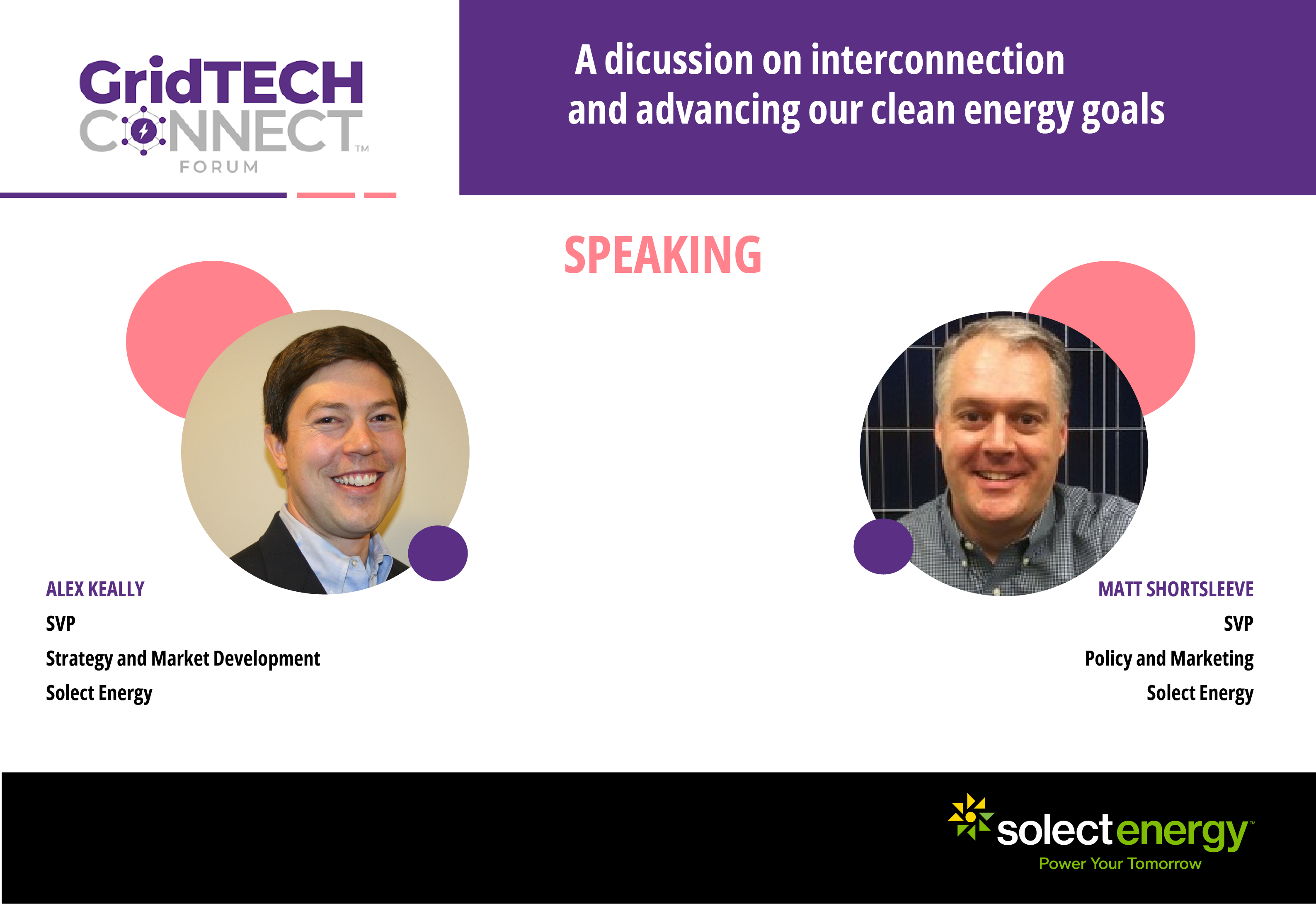
GridTECH Connect Forum Northeast


A conversation on interconnection and

advancing clean-energy goals

October 28-30, 2024 | Newport Marriott, Newport, RI

Catch Solect SVPs Alex Keally and Matt Shortsleeve at the GridTECH Connect Forum Northeast this month as they discuss interconnection and advancing clean energy goals!

Despite New England’s progress toward 100% renewable energy, several key challenges remain, including the intermittent nature of wind and solar, limited space for large-scale projects, and increasingly severe weather conditions. The region needs to modernize its grid to integrate distributed energy resources, manage peak demand, and address the growing “duck curve”, while inconsistent policies and regulations across states continue to hinder advancement. This conference provides a valuable platform for insightful discussions on these critical issues and more.

Use promo code SPKGUEST for $50 off registration. Let’s drive the future of clean energy together!

Have questions? write to us at info@solect.com, and we’ll be sure to get back to you promptly.

Transit Housing on the Rail

A New England Real Estate Journal and MSCC Housing & Transit Summit

October 17, 2024 | Showcase Cinema de Lux; Randolph , MA | 8:30 am – 11:30 am

Join Team Solect at this exciting event focused on Opportunity Zones, new housing developments, transportation, infrastructure enhancement, and the future of the Metro South region. It features a panel discussion driven by regional leaders from organizations like MassDOT, Bridgewater State University, the Citizens’ Housing and Planning Association (CHAPA), the Brockton Area Transit Authority, and more.

Don’t miss this opportunity for an engaging discussion over a complimentary breakfast, followed by a networking session to connect with industry veterans and thought leaders.

Have questions? write to us at info@solect.com, and we’ll be sure to get back to you promptly.

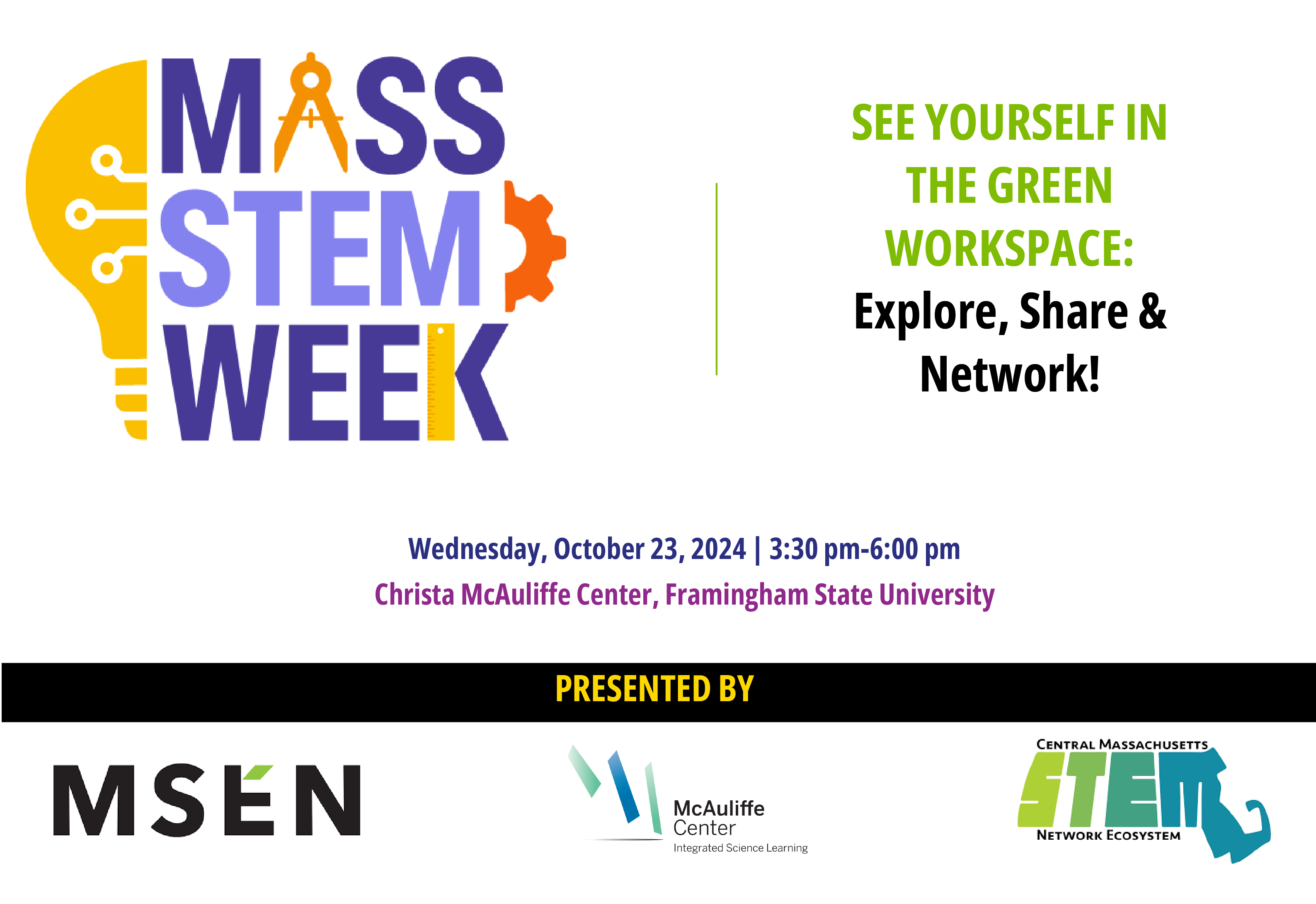
See Yourself in the Green Workspace: Explore, Share & Network!

By the MetroWest STEM Education Network and
Christa McAuliffe Center

Wednesday, October 23, 2024 | Christa McAuliffe
Center, Framingham State University | Between 3:30pm-6:00pm

Attention high school and college students, aspiring professionals, parents, educators, and mentors!

Join Team Solect and discover exciting career opportunities in the fast-growing renewable energy industry. Learn how you can make a meaningful impact by contributing to the advancement of green energy and driving the world toward a sustainable, greener future. Let’s work together to shape tomorrow’s energy landscape!

Have questions? write to us at info@solect.com, and we’ll be sure to get back to you promptly.

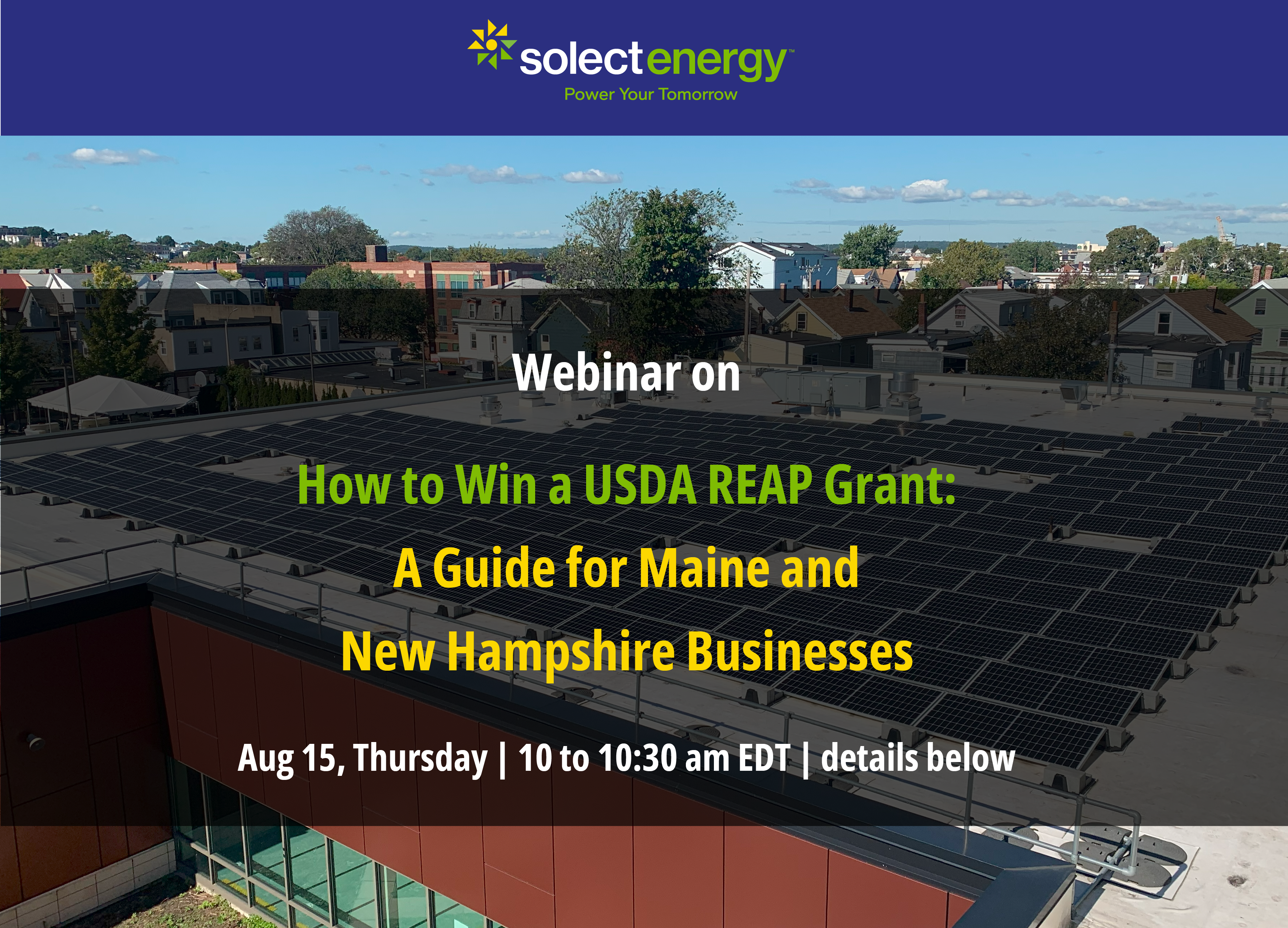
Mastering USDA REAP Grants: Join Our Webinar

How to Win a USDA REAP Grant: A Guide for Maine and New Hampshire Businesses

Thursday, Aug 15th, 2024, 10:00 am – 10:30 am | Free

USDA REAP funding is at an all-time high, with 95% of Maine and New Hampshire qualifying as eligible areas—and the best part is agricultural use isn’t required.

Join our free webinar to learn the key steps to secure a USDA REAP grant, including eligibility, application scoring, and timelines. We’ll also cover additional federal and state incentives to help further reduce your project costs.

Gain insights from Solect’s experienced team–featuring senior directors Andrew Hickok and
Ted Rioux–and optimize your chances of success. Don’t miss out on this opportunity for significant funding—register today!

Have questions? write to us at info@solect.com, and we’ll be sure to get back to you promptly.

8th Annual Northern New England CRE Summit

by New England Real Estate Journal (NEREJ)

Wed, Aug 14th, 2024, 8:30 am – 11:30 am | The Venue at the Portwalk, Portsmouth, NH

With the commercial real estate industry evolving at an unprecedented pace, join us at the 8th Annual Northern New England CRE Summit to explore the key driving forces defining the industry’s present and future.

Solect senior executives, Scott Howe and Ted Rioux will be there to meet with you at the summit and offer their extensive industry insights on the importance of solar adoption highlighting its environmental benefits and the significant savings potential it offers for your CRE business in today’s market.

Additionally, the summit brings together some of the industry’s top leaders to discuss a range of critical issues including the following:

  • Market overview
  • Interest rates
  • Availability of financing
  • 1031 exchanges
  • Construction trends
  • Supply chain issues
  • Engineering trends

As one of the Northeast’s leading commercial solar developers, Solect Energy specializes in designing and developing solar and bettery energy storage systems tailored to meet our customers’ unique needs, challenges, and savings objectives. Explore our diverse portfolio to see some of the significant projects we’ve developed for some of the region’s leading CRE brands.

Visit our table for in-depth discussions with our team over a complimentary breakfast buffet.

Have questions? write to us at info@solect.com, and we’ll be sure to get back to you promptly.

Mid-Maine Chamber of Commerce Business to Business Showcase (booth 72)

Tuesday, May 21, 2024 | 12 – 6 p.m |
Thomas College, Field House; Waterville, ME

Controlling energy expenses has become a pressing challenge in today’s business landscape. With energy consumption rising steadily, exploring effective solutions to address its financial impact without further ado is essential. Additionally, amidst the escalating climate crisis, it’s our responsibility to embrace sustainability practices for a healthier and greener future. Thankfully, the answer is simple: solar and battery energy storage systems (BESS).

By harnessing clean energy, your business can bolster savings, advance its sustainability initiatives, foster a cleaner economy, and elevate its brand reputation in the industry.

As a premier commercial solar and energy storage development company in the Northeast, Solect Energy is noted for crafting tailored solar and BESS solutions for businesses, commercial and industrial entities, as well as public and nonprofit organizations, spanning over a decade. Our seasoned team is dedicated to designing the optimal solar and storage solution according to your unique challenges, expectations, energy consumption patterns, available spaces, financial considerations, and more.

Let’s discuss how your business can further improve savings and optimize your sustainability objectives.

For inquiries, please feel free to reach out to us.

Explore the event page for more.

Aligning Education with STEM Workforce Needs

June 5, 2024, 8:30 am to 10: 30 am | MassBay Community College, Framingham, MA

Join us for a dynamic panel discussion hosted by Solect Energy in collaboration with MSEN (MetroWest STEM Education Network), Framingham State University, and MassBay Community College on June 5 at the MassBay Community College campus in Framingham, MA.

As a leading commercial solar developer, Solect Energy is powered by a dedicated team of industry experts and visionary leaders who recognize the critical link between education and the future of our workforce. We are committed to nurturing tomorrow’s professionals with the guidance and training they need to propel advancements in science and technology for years to come.

The panel discussion explores strategies for equipping our students with the skills and expertise necessary to drive sustainable scientific and technical growth crucial for enhancing the clean energy sector further.

Learn more about this event and reserve your spot by clicking here.

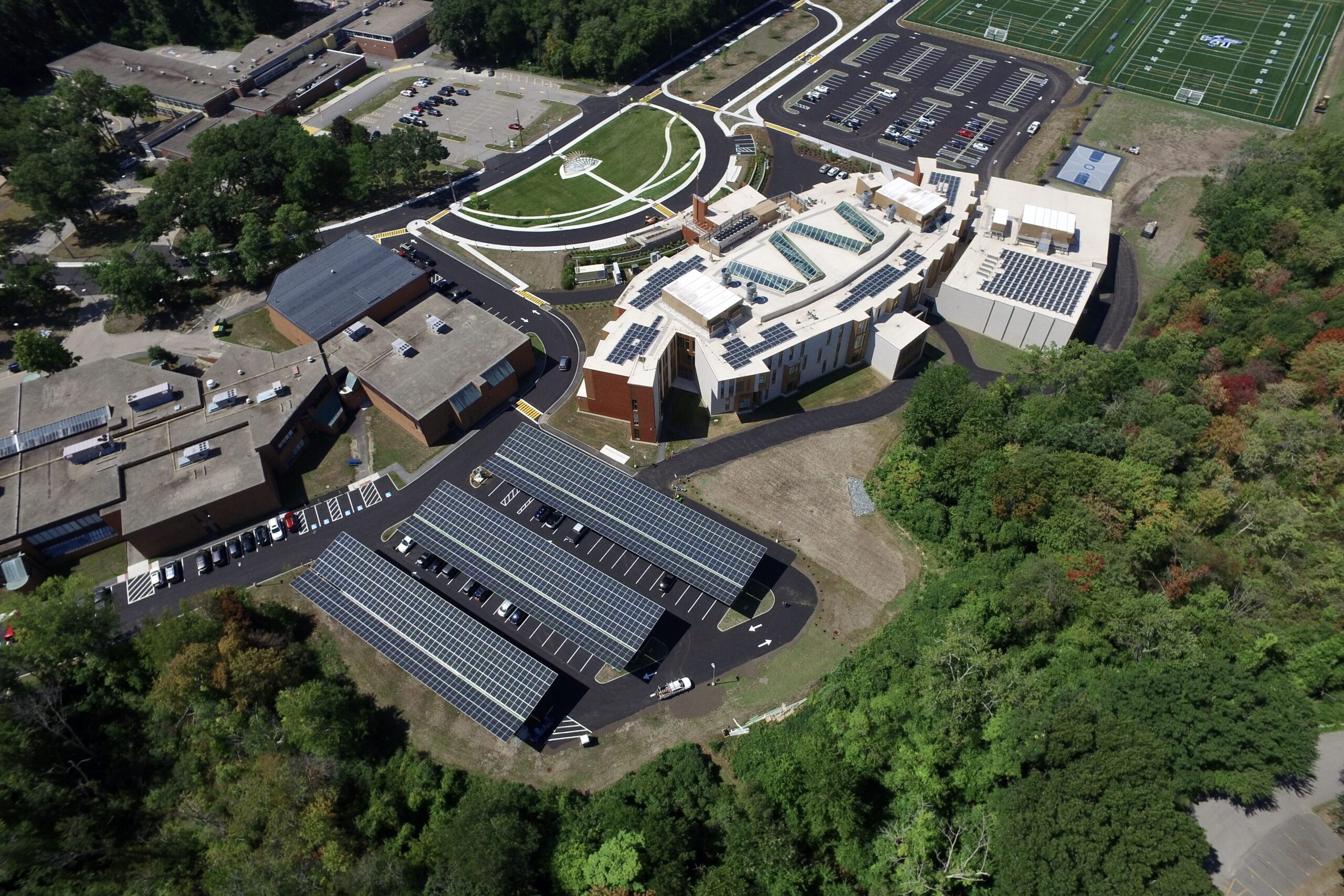
But that’s not all – explore the rooftop solar project and solar canopy developed by Solect Energy at the MassBay Community College campus in Framingham, with a combined production capacity of 442 kW. Let’s discuss how embracing solar energy can not only lead to significant cost savings but also make a powerful statement about your commitment to sustainability.

Have questions? write to us at info@solect.com, and we’ll be sure to get back to you promptly.

Annual Summit on Maine’s Economy & Climate Change

May 9th, 2024, 8am to 5pm | Augusta Civic Center, Augusta, Maine

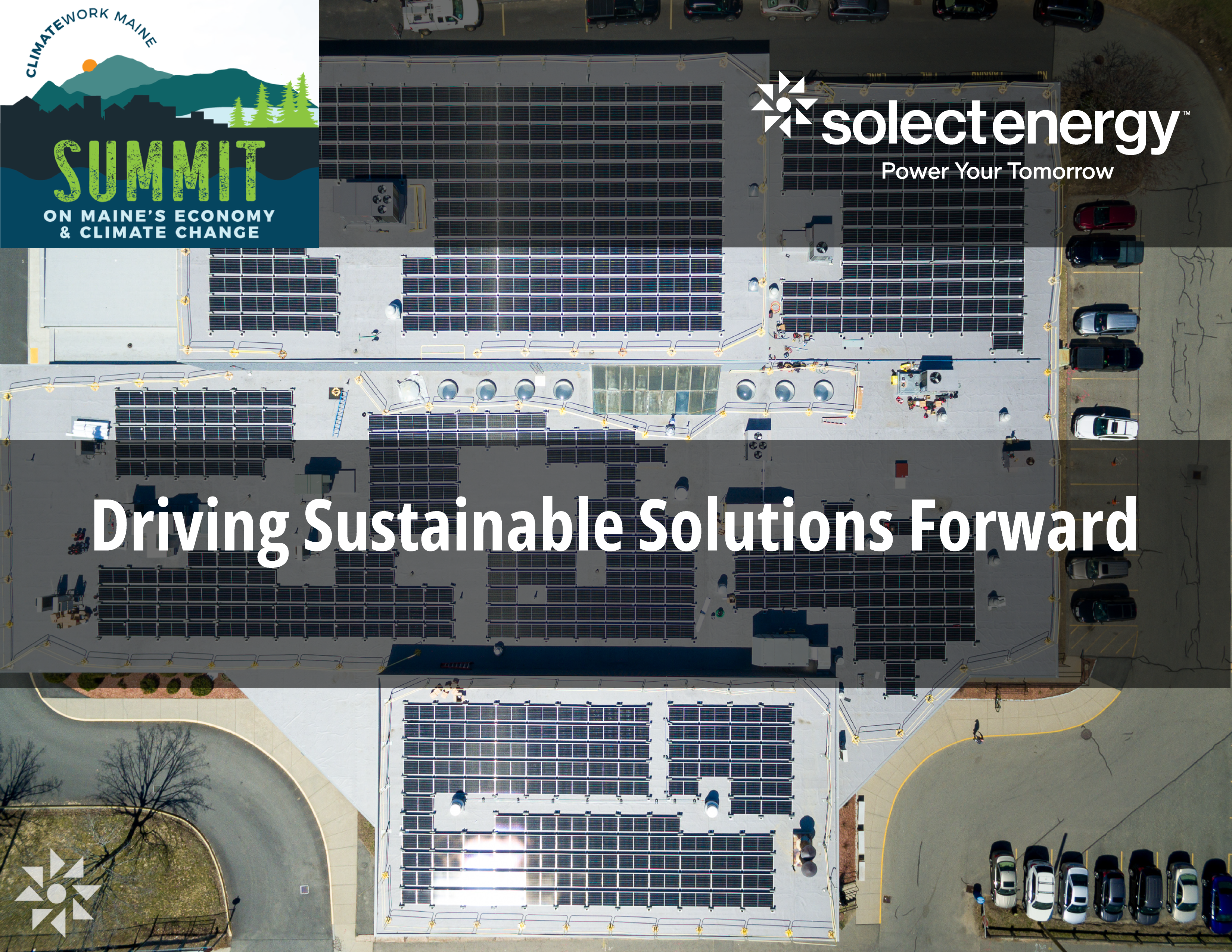
Solect Energy, one of the leading commercial solar developers in the Northeast, is thrilled to participate in the forthcoming Annual Summit on Maine’s Economy & Climate Change.

At Solect, we deeply understand the pressing need to combat climate change, which inspires our commitment to developing a cleaner, greener, and more sustainable future. By championing the widespread integration of solar energy solutions, we actively contribute to mitigating carbon emissions while empowering our clients to unlock substantial savings and achieve remarkable returns on their solar investments.

Join our team at the upcoming conference and let’s discuss how to implement the necessary changes essential for a greener and cleaner Maine while mitigating the impact of climate change.

Questions? Feel free to write to us at info@solect.com.

Drop us a line here for a one-on-one discussion with Team Solect during or after the event.

MMA Boston, January 19th – 20th, 2024

MMA Boston, January 19th – 20th, 2024

Visit Us at Booth 606!

The 45th MMA Annual Meeting & Trade Show

Hynes Convention Center and Sheraton Boston

The time has never been better to consider solar adoption thanks to a number of stimuli, including the Green School Works grant (that pays K-12 public schools for roof replacement to foster clean energy projects), direct pay, and SMART incentives.

Additionally, it’s crucial to take proactive measures to comply with decarbonization mandates in alignment with the state’s commitment to achieving carbon neutrality by 2050.

Let’s discuss how team Solect can help you optimize your savings and sustainability goals with the ideal solar and energy storage solution.

Come see us at booth 606 and don’t forget to drop your business cards for a chance to win two tickets to Boston Red Sox or Worcester Red Sox games. See you there!

For any questions, drop us a line here.