
How Federal Deadlines, Compliance Obligations, and Ownership Options Are Reshaping Solar Decisions for Businesses and Public Entities
At a Glance
- Site-ready solar projects contracted in 2026 may still qualify for the 30% federal tax credit if operational by December 31, 2027.
- Expanding building-performance requirements are increasing the financial cost of delaying energy and emissions improvements.
- Direct ownership, power purchase agreements, site leases, and portfolio-level strategies give organizations multiple ways to create value from solar, depending on their energy use, capital priorities, timing, and site readiness.
Introduction
Businesses, municipalities, schools, nonprofits, and other organizations are navigating a fast-changing energy landscape shaped by increasing electricity demand, rising electricity costs, and expanding building electrification ordinances. Distributed solar is the lowest-cost and fastest technology to deploy to meet this moment. However, changes to federal tax incentives and project qualification deadlines are making the timing and structure of solar projects increasingly important.
Organizations considering solar now need to evaluate not only whether a site is suitable, but also how quickly a project can be developed, how it fits with capital and facility plans, and which ownership or financing structure will deliver the greatest long-term value.
This market update covers the federal incentive deadline, the compliance costs building performance ordinances can create, the ownership and financing structures available, and how to choose a partner who can execute within the prescribed timelines.
The Window for the Federal Tax Credit Is Narrowing
The 30% Investment Tax Credit (ITC) remains available for qualifying projects, and accelerated bonus depreciation continues to provide significant tax benefits for eligible taxable entities.
What’s changed is the ITC timeline. The construction-start deadline that allowed projects to lock in a longer completion window has passed. Systems starting construction now must be placed in service by December 31, 2027, to qualify for the ITC. That is workable for many projects if contracted in 2026, but leaves little room for delays in permitting, utility interconnection, procurement, or construction.
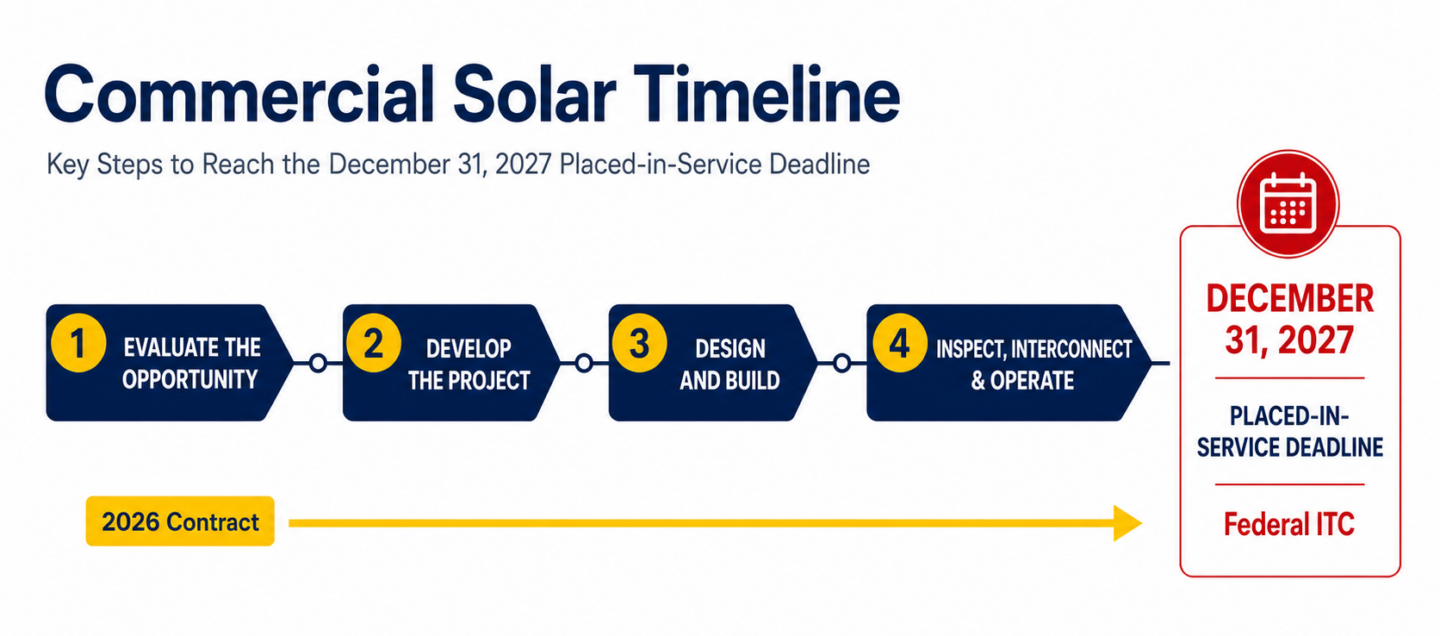
Evaluating sites now provides more time to compare ownership and financing structures, coordinate solar with capital improvements or roof replacement projects, and align installation schedules with other facility priorities.
While the fundamentals of solar remain strong with and without the ITC, projects that monetize 30% of the project cost will have superior financial returns.
Building Performance Requirements Raise the Stakes
The ITC is not the only clock running. State and local building codes, emissions-reduction targets, and organizational sustainability commitments are creating new performance expectations and, in some cases, financial obligations for organizations that own and operate commercial and institutional buildings. Although many policies include transition periods, organizations need to begin planning and implementing improvements early enough to meet increasingly stringent requirements.
In Massachusetts, policies such as BERDO in Boston, BEUDO in Cambridge, and Large Building Energy Reporting (LBER) are encouraging building owners to reduce emissions and improve building performance. Similar policies are emerging throughout the Northeast.
For many building owners, these policies have moved beyond reporting requirements and now include real fees for non-compliance. Buildings in Boston that exceed their BERDO emissions limits face Alternative Compliance Payments of $234 per metric ton of CO₂e plus $1,000 per day for every day of non-compliance. Onsite solar can directly offset that exposure. Eligible Massachusetts Class I Renewable Energy Certificates from qualifying onsite or offsite renewable energy resources may also be used to support BERDO compliance, subject to applicable program requirements.
Potential Compliance Costs Avoided with Onsite Solar
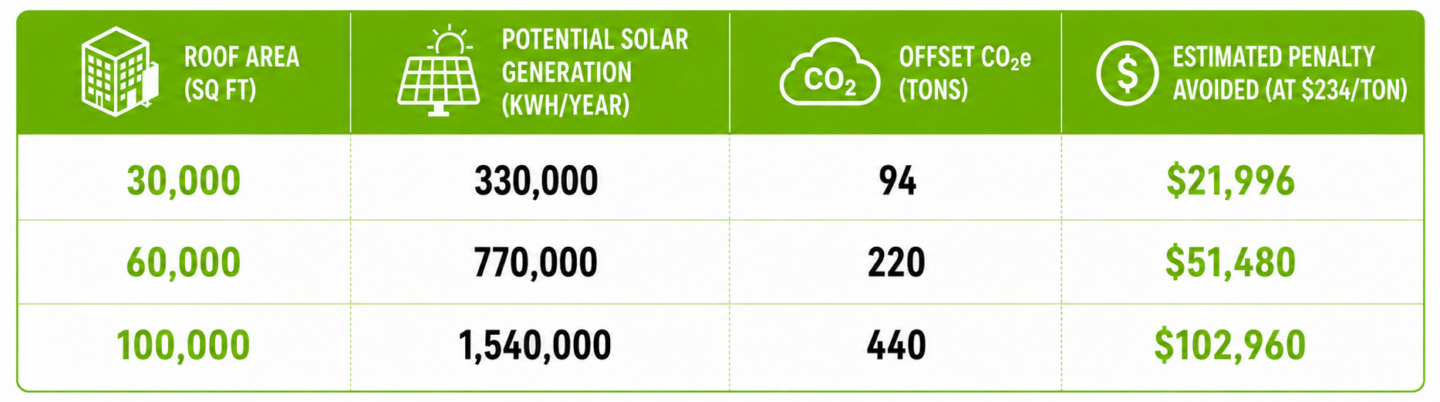
While this example is specific to Boston, it illustrates how building-performance policies can have measurable financial implications for organizations that own covered buildings. Actual solar production, emissions reductions, and avoided compliance costs will vary based on building energy use, system design, applicable emissions limits, and reporting requirements.
Choosing the Right Solar Ownership and Financing Approach
Rooftops, parking lots, and available land can host solar installations that create near-term and long-term financial value. The right structure depends on factors such as energy use, available capital, tax status, site readiness, project timing, and organizational priorities.
Direct Ownership
Behind-the-Meter
Where an organization pays the electric bill, installing solar behind the meter can reduce the amount of electricity purchased from the utility and limit exposure to volatile and rising grid-delivered electricity costs. Depending on the project and jurisdiction, additional value may come from state incentives, federal tax benefits and depreciation for eligible taxable entities, and reduced building-performance compliance costs.
Front-of-the-Meter
An organization may also invest in a system that sends electricity directly to the grid. Rather than offsetting onsite electric use, the project generates revenue through a long-term tariff agreement with the utility. Depending on the applicable state program, this can provide a predictable long-term income stream.
Power Purchase Agreements
For organizations that want the benefits of onsite solar without purchasing and owning the system, a power purchase agreement provides a third-party-owned option. The solar developer finances and owns the project, allowing the host organization to benefit from solar without making the upfront capital investment.
Because the developer owns the system, available federal tax benefits and ITC-eligible equipment can be incorporated into the project’s economics, potentially supporting more competitive energy pricing.
Solar Site Leases
For organizations that do not want to invest capital, cannot use available tax benefits, or have property better suited to a third-party-owned project, a solar site lease may be the stronger option. The developer finances and maintains the project and pays rent to the property owner. Depending on the configuration and applicable solar program, the project may also contribute to building-performance compliance.
In preparation for the ITC safe harbor deadline, Solect invested in more than 100 MW of solar equipment intended to support future projects. Because Solect can finance and own site-lease and power-purchase-agreement projects, ITC-eligible equipment and federal tax benefits can be incorporated into project economics, potentially supporting more competitive lease payments or energy pricing.
Allocating Solar Value Across Multiple Sites
Depending on the applicable state program and utility rules, a solar project may be able to direct bill credits to other eligible properties. This can be particularly valuable for organizations with multiple facilities looking to offset electricity costs or reduce emissions exposure across their operations.
Choosing the Right Partner
As project timing and structure become more important, organizations need a solar partner that can support more than a single transaction or installation. The right partner should be able to evaluate opportunities across one or multiple sites, recommend the structure that best aligns with the organization’s goals, and carry projects from initial feasibility and financing through design, construction, commissioning, and long-term asset management.
That requires financial strength, policy and market expertise, in-house design and engineering resources, proven installation capabilities, and a strong record of operating and maintaining solar assets over time.
Since 2009, Solect Energy has grown into one of the largest commercial solar developers in the Northeast. Solect develops and delivers both customer-owned and third-party-owned solar projects, giving organizations the flexibility to pursue the structure that best aligns with their financial, operational, and facility priorities.
As a Pattern Energy company, Solect also brings the financial resources and long-term perspective to support organizations as individual sites become solar-ready over time. Roof conditions, capital plans, utility interconnection opportunities, project economics, and other facility priorities can all affect timing.
Solect is positioned to work with organizations year after year, developing projects as sites and opportunities align and carrying them through installation and decades of operation.
Evaluate Now to Preserve Your Options
The federal ITC deadline and expanding building performance requirements are converging on the same timeline, making it increasingly important to evaluate properties now. For site-ready properties, direct ownership may allow owners to capture the federal tax benefits while they remain available. For other properties, a power purchase agreement or site lease structure can incorporate federal incentive value into the project economics without requiring the owner to make the investment. Organizations that begin evaluating their portfolios today will retain greater flexibility to compare structures, align projects with capital plans, and capture the strongest available financial benefits.
Call 508-598-3511, email info@solect.com, or use the button below to talk with our team. For many properties, it’s one of the strongest financial moves available today.
August 27, 2026